Austin WeatherSat
A paper design for a 2U cubesat that would send live video of Texas, with forecasting and analysis done on the ground.
- Status
- Concept study
- Period
- Nov 2026
- Discipline
- Research
- Reference
- KL-M3
Overview
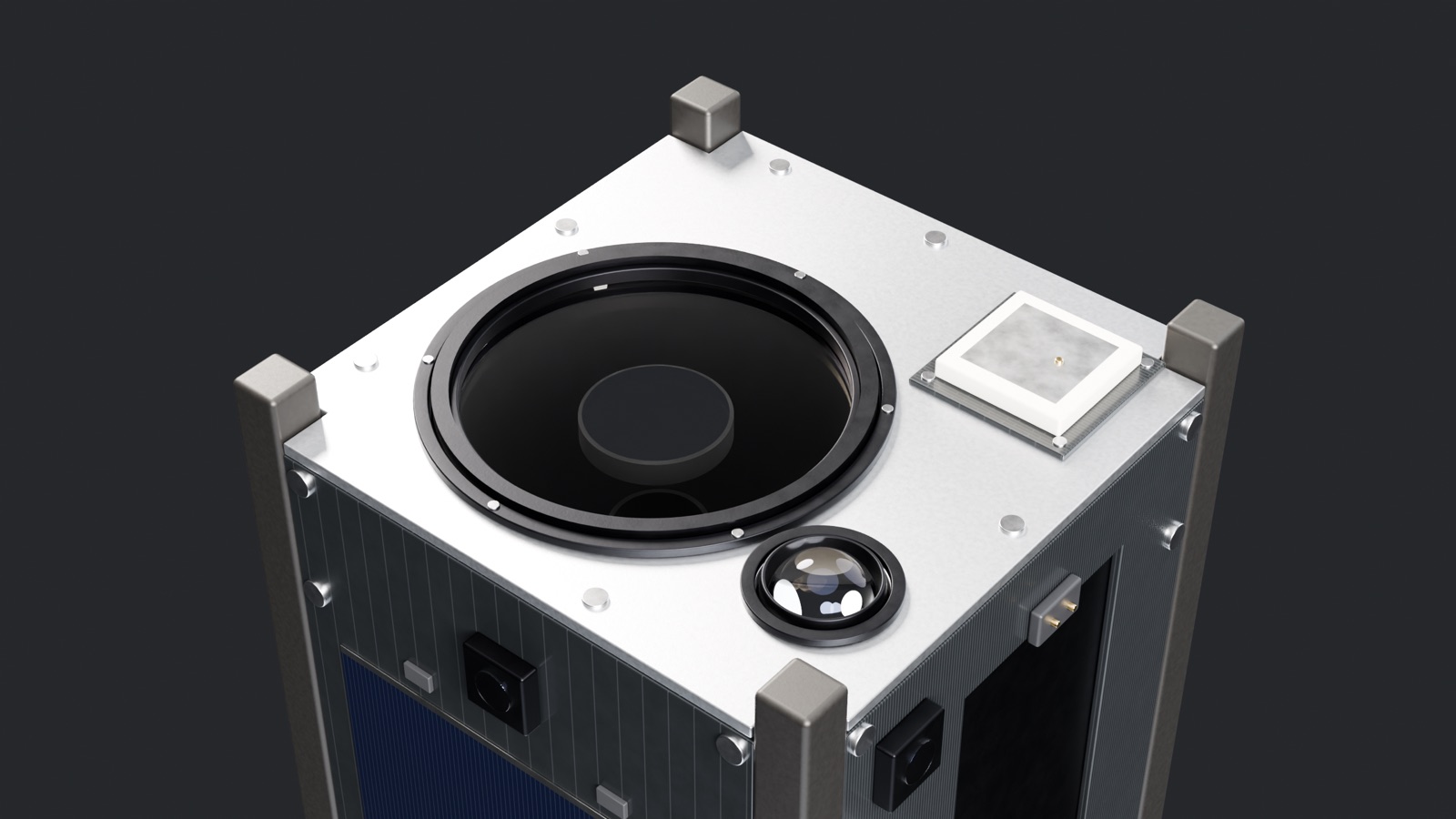
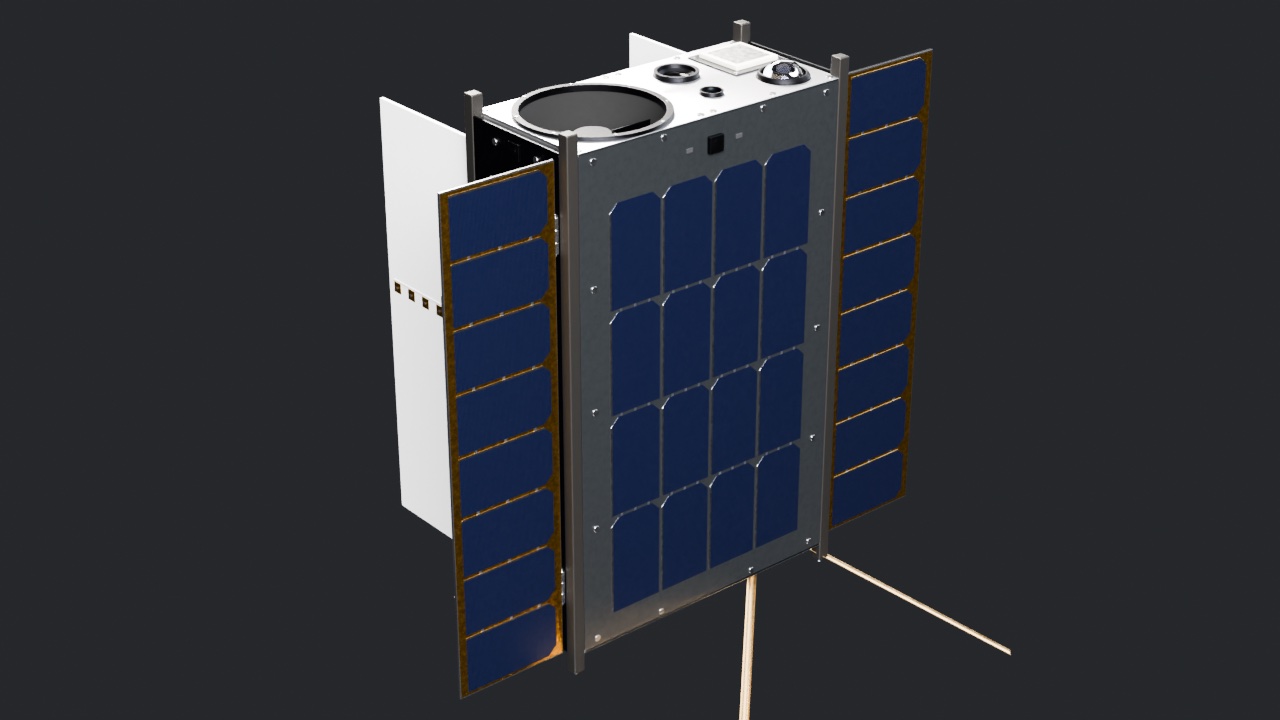
Austin WeatherSat is a paper design for a personal, non-commercial cubesat. It is now on its third draft, a 2U satellite estimated at 2.37 kg with one job: send live video and pictures of its pass over Texas and of the weather, and leave the thinking to computers on the ground. Two fixed cameras would look straight down from 500 km. A 12-megapixel sensor behind a 185° fisheye would see from horizon to horizon, at about 500 m per pixel in the centre. A 26-megapixel sensor behind a 300 mm mirror lens would cover 39.1 by 26.1 km at 6.27 m per pixel.
The zoom comes from a mirror lens that folds 300 mm of focal length into a barrel 75 mm long, and from cropping the large sensor, with no moving parts. I moved the computing to the ground: the satellite would carry a camera controller and a video encoder and nothing smarter, which removes the 11 W computer of the earlier drafts and its cooling and is most of why the design fits in 2U. The limits are plain. A house would be about two pixels, and a 42 mm aperture resolves about 8 m at best. Video would be live only while the satellite is above the ground station's horizon. With no star tracker, attitude would come from fitting the horizon in the fisheye image, which is unproven, and the radio rates are targets with no link analysis behind them.
What ran for this draft is software. A Python package called spotter models the orbit, the cameras, ground-station passes and frame stacking, with 91 tests recorded as passing. Over a simulated 30 days a station in Austin gets 1.4 daylight passes and 8.2 minutes of live video a day. Stacking 30 simulated frames resolved 9.1 m stripe spacing against 13.8 m for one frame at the same noise, and the camera model was also run over public aerial photographs of Austin. For the daylight hours between passes the design would send about 2 frames a second and rebuild full-rate video on the ground, a day late. Tried on four 40-second clips of public space-station footage with HEVC at 40 kbps, the rebuilt video scored a mean VMAF of 79, against 42 without rebuilding.
The first draft was a 3U that carried a radiator experiment, since dropped, and would forecast on board, sending down the chance of rain in the next 24 hours. The forecast prototype did run, on 2,539 daily images from the public NOAA GOES-16 archive, 2018 to 2024, paired with airport weather observations. Trained and tuned on 2018 to 2023 and tested once on 2024, a logistic regression on a few dozen image statistics scored best, ahead of boosted trees and a 51,138-parameter convolutional network, and all three beat every baseline that did not use the image. The negative results stay in. The network showed no meaningful skill at predicting temperature change: 4.3 °F average error against 4.5 °F for assuming no change. The test covers one year with 75 rainy days, uses an idealised camera with no fisheye distortion or spin, and was never compared with a professional forecast.
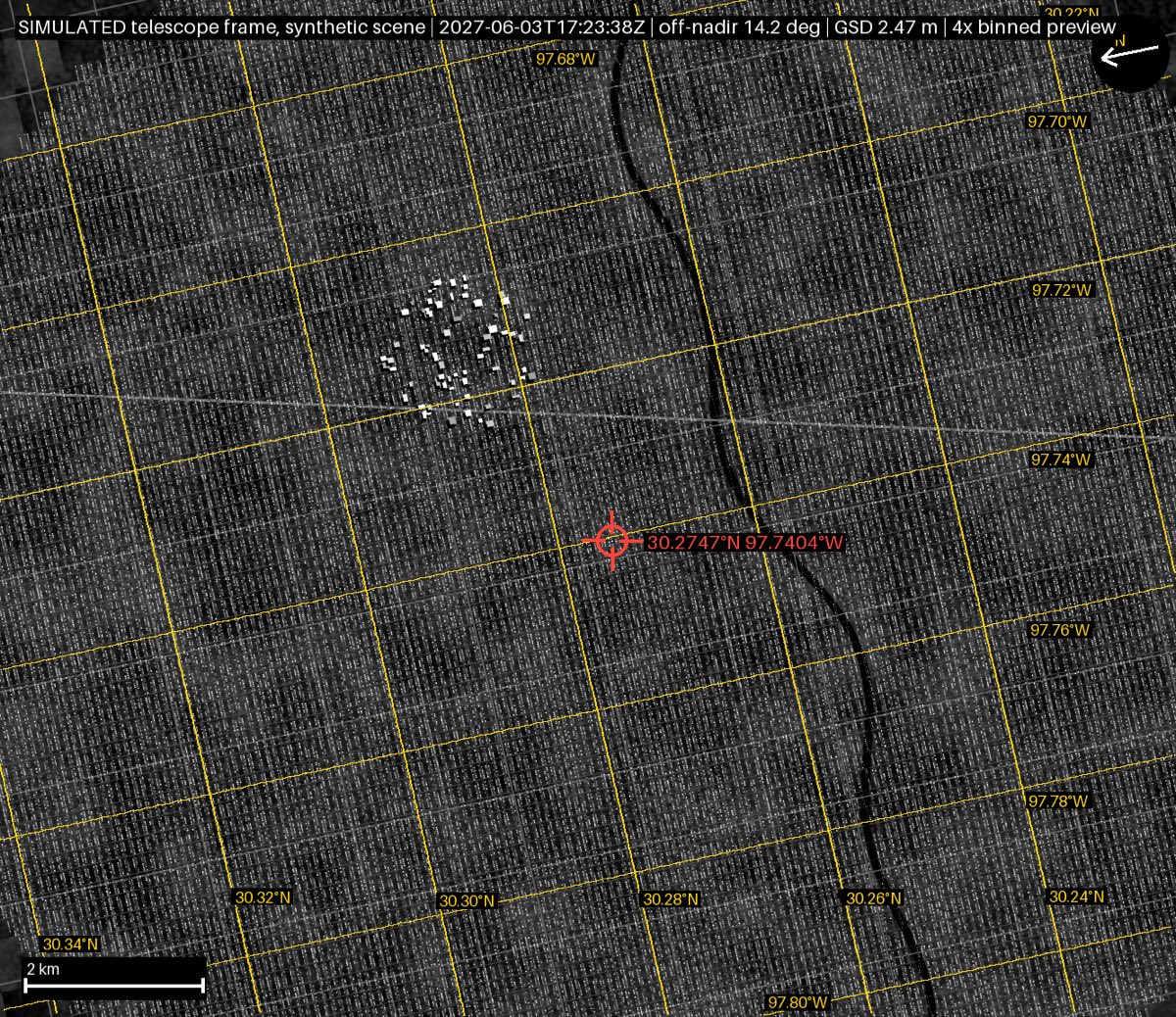
The second draft was a 6U that could photograph a requested coordinate through a 90 mm aperture telescope at about 2.4 m per pixel. The first version of spotter was written for it. It finds imaging opportunities, computes pointing, maps every pixel to latitude and longitude and refines that against a reference map by phase correlation, end to end on a synthetic scene only. I dropped the telescope the same day for the smaller 2U. Most of the work in all three drafts was produced by AI coding agents working to my direction.
Specifications
- The zoom camera design is a 26-megapixel APS-C sensor behind a 300 mm f/7.1 mirror lens with a 42 mm aperture: 6.27 m per pixel over a 39.1 by 26.1 km frame from 500 km.
- Over a simulated 30 days, a ground station in Austin sees 2.9 passes a day above 10°, 1.4 of them in daylight, for 16.3 minutes of contact and 8.2 minutes of live video a day.
- In a best-case simulation, 30 stacked frames resolve 9.1 m stripe spacing at the noise of one frame, against 13.8 m for a single frame. Nothing finer than the modelled lens's 6.5 m cutoff appears.
- In the stream test, 2 frames a second encoded with HEVC at 40 kbps and rebuilt to full rate scored a mean VMAF of 79, and 71 at the fifth percentile of frames. Shown without rebuilding, the same stream scored 42, and a full-rate encode at 36 kbps scored 11.
- The forecast dataset holds 2,539 daily GOES-16 images from 2018 to 2024. The 2,529 days with usable weather observations were split 1,810 train, 363 validate and 356 test.
- On the 2024 test year, logistic regression on image statistics reached a Brier score of 0.105, 40% skill over the seasonal average, and an AUC of 0.89. The best baseline without an image scored 0.152.
- The small convolutional network has 51,138 parameters and scored a Brier of 0.118 and AUC of 0.86, behind the simpler model.
- In the 6U draft's simulation, registering a frame against a 10 m reference map cut the injected geolocation error at the requested point from 242.5 m to 0.26 m, a best case on a synthetic scene.